Dear Friends,
We hope this week's devotional will encourage you in your spiritual walk. We give thanks to Dr Randy Cloud, Interim Academic Dean, for writing this devotional. You are welcome to share this and include it in your church newsletters if you wish; we just ask that you please give credit to NTC and the author. Thank you!
Jeremiah 32:1-3, 6-17
This is the word that came to Jeremiah from the Lord in the tenth year of Zedekiah king of Judah, which was the eighteenth year of Nebuchadnezzar. 2 The army of the king of Babylon was then besieging Jerusalem, and Jeremiah the prophet was confined in the courtyard of the guard in the royal palace of Judah.
3 Now Zedekiah king of Judah had imprisoned him there, saying, “Why do you prophesy as you do? You say, ‘This is what the Lord says: I am about to give this city into the hands of the king of Babylon, and he will capture it.’”
6 Jeremiah said, “The word of the Lord came to me: 7 Hanamel son of Shallum your uncle is going to come to you and say, ‘Buy my field at Anathoth, because as nearest relative it is your right and duty to buy it.’
8 “Then, just as the Lord had said, my cousin Hanamel came to me in the courtyard of the guard and said, ‘Buy my field at Anathoth in the territory of Benjamin. Since it is your right to redeem it and possess it, buy it for yourself.’
“I knew that this was the word of the Lord; 9 so I bought the field at Anathoth from my cousin Hanamel and weighed out for him seventeen shekels[b] of silver. 10 I signed and sealed the deed, had it witnessed, and weighed out the silver on the scales. 11 I took the deed of purchase—the sealed copy containing the terms and conditions, as well as the unsealed copy— 12 and I gave this deed to Baruch son of Neriah, the son of Mahseiah, in the presence of my cousin Hanamel and of the witnesses who had signed the deed and of all the Jews sitting in the courtyard of the guard.
13 “In their presence I gave Baruch these instructions: 14 ‘This is what the Lord Almighty, the God of Israel, says: Take these documents, both the sealed and unsealed copies of the deed of purchase, and put them in a clay jar so they will last a long time. 15 For this is what the Lord Almighty, the God of Israel, says: Houses, fields and vineyards will again be bought in this land.’”
“After I had given the deed of purchase to Baruch son of Neriah, I prayed to the Lord:
17 “Ah, Sovereign Lord, you have made the heavens and the earth by your great power and outstretched arm. Nothing is too hard for you. 18 You show love to thousands. . .”
Devotional
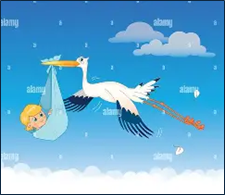
“Mommy, where do babies come from?” This cute little question posed by toddlers over eons past have proved to put parents into a bit of an embarrassed position. So, at some point in distant history, a clever parent used this still used cover-up story: Babies are brought to our homes by storks. That image of a stork carrying a newborn in its long beak is well known today. So, what do storks have to do with Jeremiah? As we will see, quite a lot actually.
Before we talk about storks in this biblical episode, we actually have another strange image to unravel. This week’s passage is placed in the final days of the Southern Kingdom of Israel, known as Judea at that time, and specifically the last days of the capitol city of Jerusalem. You might remember from your freshman Bible class that Israel, after the reigns of Saul, David, and Solomon, split into two countries north and south. The northern kingdom, because of continual disobedience to God, was destroyed and erased from the biblical story by the Assyrians. The southern kingdom fared little better, finally being consumed by the Babylonians around 600BC. Jeremiah has the difficult task to live in Jerusalem during the final days of this military siege. His hard task was to tell the king what was about to happen to him and to his city—dire news indeed. The king was so unhappy about this report that he had Jeremiah put into prison. It is here that our story picks up.
Jeremiah is lying in a jail cell when the word of the Lord comes to him. This message is strange. God tells Jeremiah to expect a visitor. One of his relatives would come to visit him and make him an impossible offer. He would ask Jeremiah to purchase some land outside of the city that the relative owned. This strategy certainly made sense to the relative. Liquidate all assets, especially land, and turn it into cash so that when the Babylonians finally took over the city in a few days, he could try to flee with money in hand to use for food and shelter. The strangeness of the request is recognized from Jeremiah’s point of view. Why would Jeremiah pay good money for land that would soon be in the hands of the enemy? In fact, the Babylonians already occupied this piece of land as they surrounded the city. Of what value would it be to Jeremiah? What a lousy business deal!
Yet our passage shows us that God intends for Jeremiah to follow through with this transaction . . . and he does. God was asking him to “put his money where his mouth was” quite literally. He meticulously signs all of the legal documents and pays a significant sum of silver for this apparently worthless plot of land. Then he does something that demands our attention. He instructs his friends to put this purchased contract and deed into a sturdy jar so that the paperwork might “last for a long time.”
The actions of Jeremiah were not practical. But they were prophetic. God had promised that the Babylonian takeover of their land would not be permanent. At some point in the future, God would redeem his people and this land. These acres of worthless land today would someday be of value again. But not in Jeremiah’s time; sometime in the future. And when that day came, this buried jar with contract intact would once again see light of day and this purchased plot would be owned by someone of Jeremiah’s family, where “houses, and fields and vineyards” would once again shape the landscape.
In spite of the people failing God and his covenant, God would always keep his end of the agreement. Maybe not in Jeremiah’s own day but its surety was guaranteed. Jeremiah’s faith in a God of promise must have encouraged at least a few of the people of his day that all was not lost. Jeremiah was acting as a beacon of hope, reminding the Israelites that their story was not over. In spite of absolutely desperate circumstances, God was not far away and his purposes were still being accomplished. The call for us today to sow seeds of faith in our homes, churches, our cities and even at NTC is the same as Jeremiah’s call. God is at work in our world and it is our privilege to proclaim that truth to everyone, even when life seems to point in the opposite direction. And our faithful work may not be evident to us now, but in the grand picture of God’s kingdom that work is being accomplished. I can just imagine the early leaders here at NTC putting their life resources to work for something that maybe just now is coming to fruition. That is our call too!
Now about the stork. The word used to describe God’s steadfast and faithful love is the Hebrew word chesed. Hebrew words are typically formed on 3-letter consonant roots. In this case, chesed is formed on the three Hebrew letters: ch-s-d. interestingly for us, the word in Hebrew for stork also is formed from these three same letters thus signifying a connection in meaning between lovingkindness and storks! It was noted even in ancient times that in the animal world mothers tenderly cared for and protected their young. But they also noted that when they considered this degree of care and protection, the stork mother ranked well above all the other animals. The stork was known for its strong love and kindness to its young and to its family. And that is how, we believe, the current stork-carrying-a-baby image was first born.
God is like a stork in all of these characteristics, multiplied by thousands. God is caring, protective, kind and full of grace. His character is on full display in our passage as he encourages Jeremiah and us to trust in his ability to make all things new, to turn trouble into triumph, and in all things work “for the good of those who love him” (Rom 8:28).
Click on this link to hear a beautiful acapella song sung in Hebrew titled Chesed. You won’t know the words but you will hear the word chesed repeated and you will feel the beauty of this choral arrangement as you think about God’s steadfast love and care in your own life.
Kind regards,
Randy Cloud (Interim Academic Dean)