
Dear Friends,
We hope this week's devotional will encourage you in your spiritual walk. We
give thanks to Dr Randy Cloud, Interim Academic Dean, for writing this
devotional. You are welcome to
share this and include it in your church newsletters if you wish; we just ask
that you please give credit to NTC and the author. Thank you!
Lamentations 1: 1-6
How deserted lies the city,
once so full of people!
How like a widow is she,
who once was great among the nations!
She who was queen among the provinces
has now become a slave.
2 Bitterly she weeps at night,
tears are on her cheeks.
Among all her lovers
there is no one to comfort her.
All her friends have betrayed her;
they have become her enemies.
3 After affliction and harsh labor,
Judah has gone into exile.
She dwells among the nations;
she finds no resting place.
All who pursue her have overtaken her
in the midst of her distress.
4 The roads to Zion mourn,
for no one comes to her appointed festivals.
All her gateways are desolate,
her priests groan,
her young women grieve,
and she is in bitter anguish.
5 Her foes have become her masters;
her enemies are at ease.
The Lord has brought her grief
because of her many sins.
Her children have gone into exile,
captive before the foe.
6 All the splendor has departed
from Daughter Zion.
Her princes are like deer
that find no pasture;
in weakness they have fled
before the pursuer.
Devotional
If you want to find the saddest of all the Old Testament passages, you have arrived. The verses above are not pretty, not encouraging, not hopeful. They illustrate stark reality of the worst kind. The book of Lamentations highlights the lowest point in Israel’s history, namely the final and complete defeat and exile of the inhabitants of Jerusalem. The city that housed the dwelling place of God as defined by Solomon’s Temple was pillaged and its citizens killed or abducted. These opening verses in Lamentations tear at the heart. The word “lament” is a deeper emotion than even weeping, referencing a profound and intense level of grief.
Interestingly, Lamentations is built on a series of alphabet acrostics, something our English Bibles cannot adequately show. Each verse of Lamentations chapter 1 begins with a succeeding letter of the Hebrew alphabet. This dirge style poetry, using all of the letters of the alphabet, gives this chapter a feeling of sadness “from A-Z.”
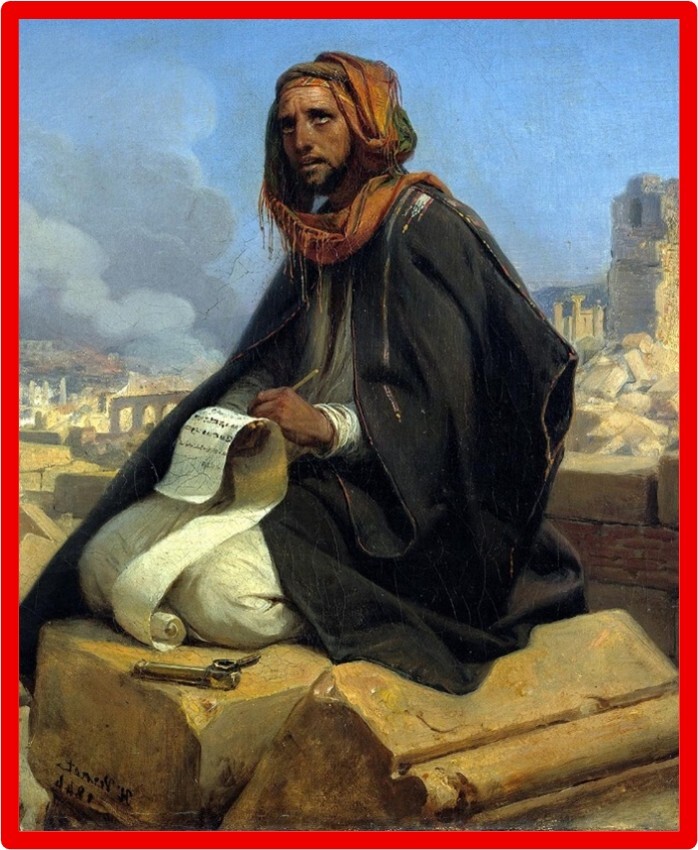
The book preceding Lamentations are the words of Jeremiah the prophet. His name is usually attached to Lamentations as well, the fifth of the Major Prophets books. The Greek Septuagint translation of the Old Testament adds these words to the opening verse: and it came to pass, after Israel was taken captive, and Jerusalem made desolate, that Jeremiah sat weeping, and lamented with this lamentation over Jerusalem and said . . . the Weeping Prophet truly had something to be sad about; his city, the people of God’s city, had been destroyed before his own eyes. Lamentations 4 describes the destruction with these non-Sunday School images: But now they are blacker than soot; they are not recognized in the streets. Their skin has shriveled on their bones; it has become as dry as a stick. Those killed by the sword are better off than those who die of famine; racked with hunger, they waste away for lack of food from the field. With their own hands compassionate women have cooked their own children, who became their food when my people were destroyed.
The final destruction of Jerusalem is also detailed in the final chapters of 2 Kings. There we see the historical facts that surround Jeremiah’s laments. The news is all bad. Had God finally given up on his people after so many second chances? Is this this end of God’s plan of salvation for the world? To find the answer to these key questions, we simply have to turn the pages of our scriptures, from the end of 2 Kings to the beginning of the very next book in our English Bibles—the book of 1 Chronicles. And what do we find there? Words of hope and a view of the future? Actually, that is exactly what we find, if we know how to look. The first chapter of 1 Chronicles contains what, for some, are verses “to be skipped” but from the biblical view they are all important. The first chapter and indeed the first nine chapters are filled with . . .names. Name after name after name. One of those pesky Old Testament genealogy lists with unpronounceable Hebrew names. The kind of chapters we are tempted to pass over so we can get to the “good material.” But in these extensive lists of names we see the faithfulness of God, who remembers each one of his people, by name, position and place. He never forgets his people. He knows us all by name no matter how far we have wandered. These lists of names are indeed the good material!
So, with the author of Lamentations we quote these familiar song verses, the only words of hope in the whole book, drawn from chapter 3, verse 23: “Great is your faithfulness!”
Great is thy faithfulness, O God, my Father;
There is no shadow of turning with thee.
Thou changest not, thy compassions, they fail not;
As thou hast been, thou forever wilt be.
Refrain:
Great is thy faithfulness,
Great is thy faithfulness,
Morning by morning new mercies I see.
All I have needed thy hand hast provided;
Great is thy faithfulness,
Lord unto me.
Kind regards,
Randy Cloud (Interim Academic Dean)